

U-bolt failure is one of the most preventable causes of trailer suspension breakdown on the road. The fix is simple: inspect your U-bolts before every tow, torque them to the correct specification, and replace them at the first sign of fatigue, corrosion, or deformation.
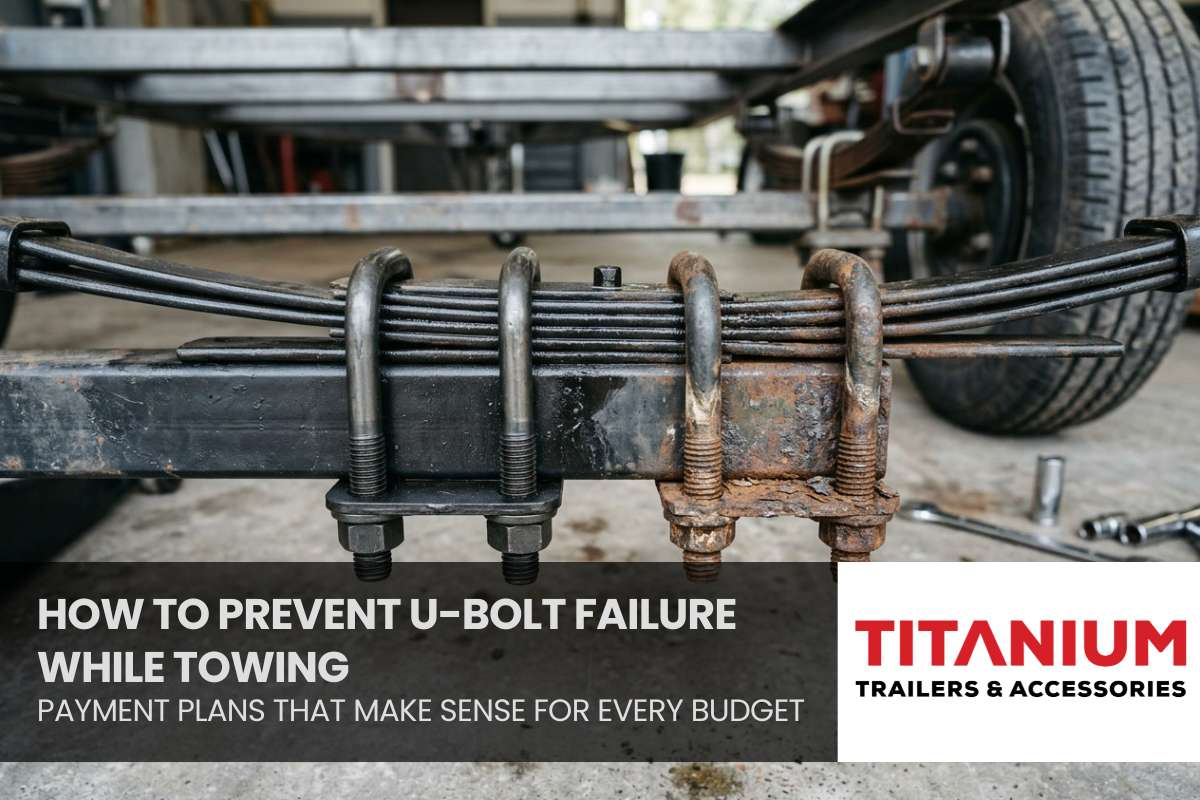
U-bolts are U-shaped steel fasteners that clamp your trailer’s leaf springs to the axle, holding the entire suspension assembly together. When they fail, the axle can shift, the suspension geometry collapses, and you lose directional control of the trailer. In North Queensland, where corrugated outback roads, coastal humidity, and heavy payloads push equipment to its limits, a disciplined pre-towing routine is the best defence against a roadside emergency.
This guide covers the causes of U-bolt failure, a step-by-step inspection checklist you can complete in under 15 minutes, correct torque specifications by bolt diameter, and the warning signs that mean immediate replacement.
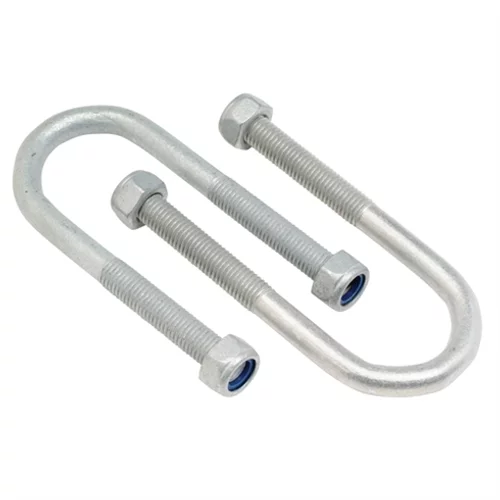
U-bolts provide the clamping force that locks your trailer’s leaf spring pack, axle seat, top plate, and axle into a single rigid unit. According to Dayton Parts, virtually all leaf spring failures through the centre bolt hole are caused by inadequate U-bolt clamping. That makes U-bolt condition the single most important factor in trailer suspension integrity.
There are five primary causes of U-bolt failure.
Overloading puts stress on U-bolts beyond their rated capacity. When a trailer exceeds its Gross Trailer Mass (GTM), the U-bolts absorb forces they were never designed to handle, leading to stretching, deformation, or outright fracture.
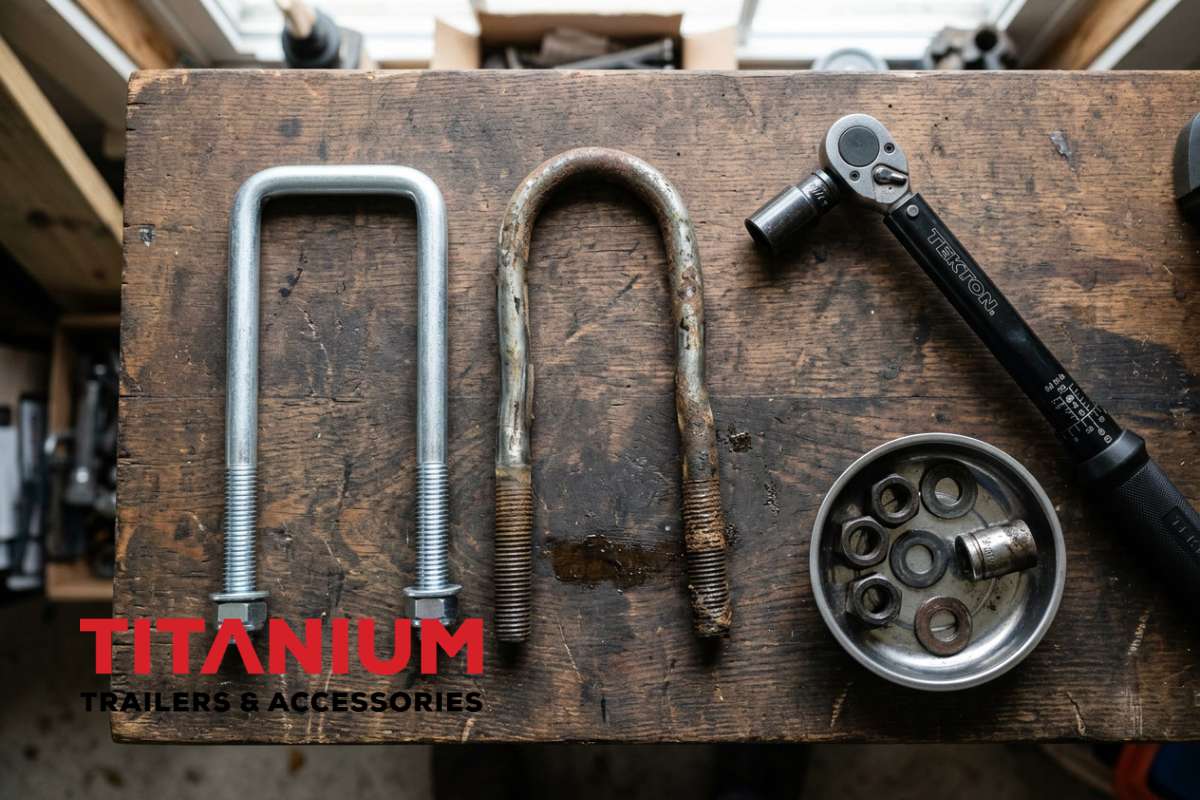
Corrosion and rust weaken the steel over time, especially in coastal regions like Townsville and Cairns where salt air accelerates deterioration. Surface corrosion may look minor, but pitting on the bend radius or at the thread root creates stress concentration points where cracks begin.
Fatigue from vibration is the silent killer. U-bolts absorb continuous road vibrations while holding the spring pack together. Over thousands of kilometres, this cyclic loading causes microscopic cracks to form and grow, even when the U-bolt has never been overloaded. Grade 8 U-bolt material offers approximately 40% higher yield strength than Grade 5 and is the recommended choice for most trailer applications.
Incorrect torque during installation causes problems at both extremes. Under-torquing allows the suspension components to shift and vibrate loose. Over-torquing overstresses the bolt at the bend radius, creating premature fatigue and potential thread damage.
Improper fit or reuse is more common than most owners realise. A used U-bolt has already stretched under load, and its damaged threads make reaching proper clamping force extremely difficult. According to industry data from Dayton Parts, reusing U-bolts with worn threads can reduce clamping force by over 55%, even when the torque wrench reads the same value.
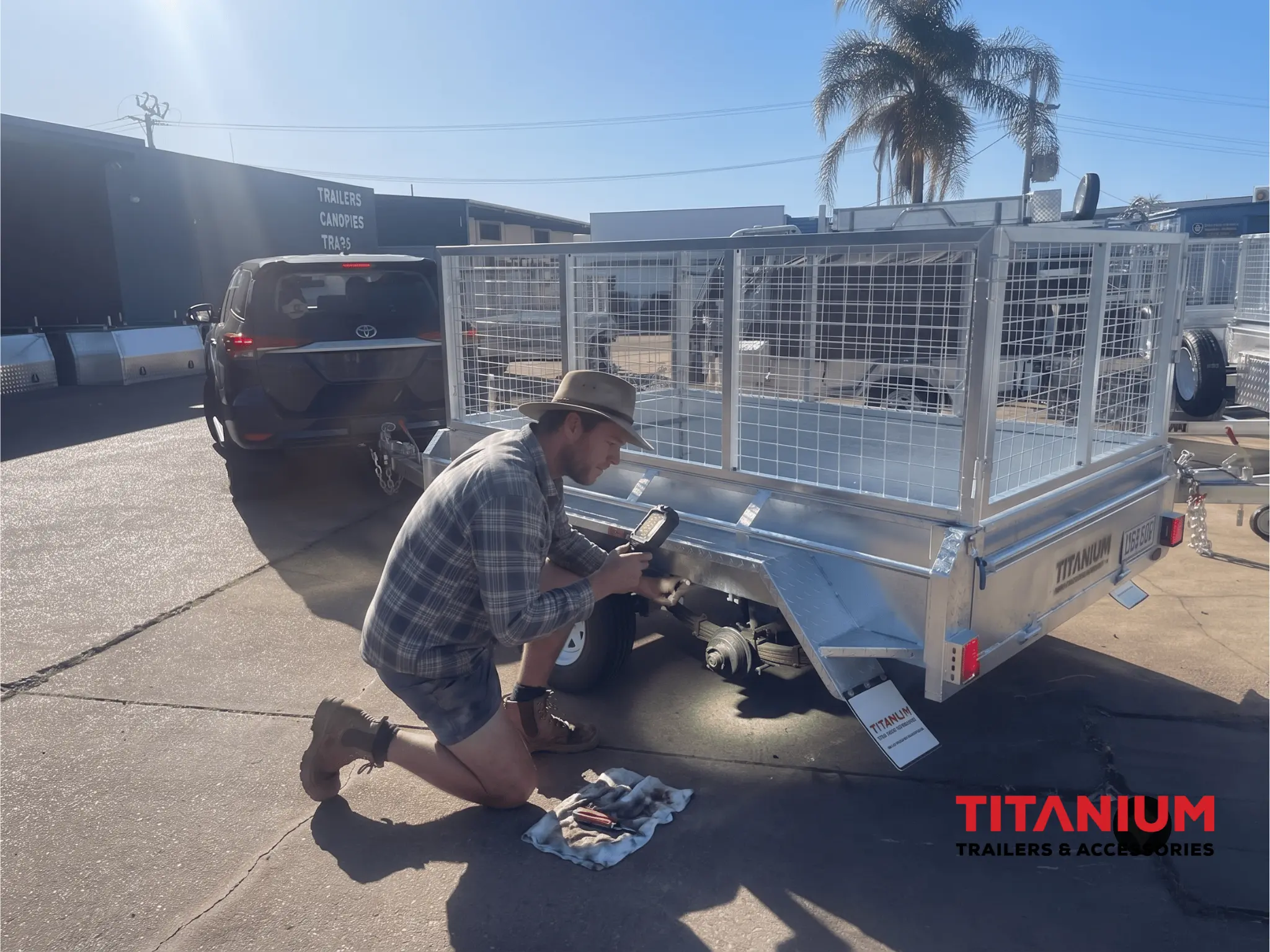
A thorough U-bolt inspection takes less than 15 minutes and can prevent catastrophic suspension failure. Complete these checks before every tow, and repeat them every two to three hours on long trips as recommended by Queensland’s Department of Transport and Main Roads.
Step 1: Visual inspection for corrosion and cracks. Get under the trailer with a torch and examine each U-bolt closely. Look for rust, pitting, surface cracks, or any discolouration around the bend radius. If you spot cracks at any point on the bolt, replace it immediately. Do not attempt to weld, repair, or re-bend a compromised U-bolt.
Step 2: Check for shifting or movement. With the trailer on flat ground, try to move the leaf spring pack and axle by hand. Any noticeable lateral movement or a spring pack that feels loose indicates the U-bolts have lost clamping force. Worn or polished surfaces on the axle seat or top plate are clear indicators that unwanted movement has occurred between the components.
Step 3: Measure ride height. Measure from a fixed point on the trailer frame to the ground on both sides. A difference of more than 12 mm (approximately 1/2 inch) between the driver and passenger side suggests a dropped or misaligned spring, which often points to a failing U-bolt on that side.
Step 4: Inspect the threads and nuts. Check that all nuts are present and that the threads above each nut are not stripped, galled, or showing signs of galling (a form of cold welding caused by friction between metal surfaces). Thread damage means the bolt cannot maintain proper tension and needs replacing.
Step 5: Verify torque with a calibrated wrench. Using a torque wrench, confirm that each U-bolt nut sits within the manufacturer’s recommended torque range. Do not simply “check tightness” by feel. Refer to the torque specification table below for the correct values by bolt diameter.
Step 6: Inspect the top plate and axle seat. These components sit between the U-bolt and the spring pack. Look for cracks, warping, or wear marks. A damaged top plate distributes clamping pressure unevenly, which accelerates U-bolt fatigue even when torque is correct.
If you are unsure about the condition of your trailer’s suspension, visit a Titanium Trailers showroom for a professional assessment. Our teams in Townsville, Rockhampton, Brisbane, and Cairns can inspect your suspension and recommend the right replacement components.

Correct torque is critical. Under-tightened U-bolts allow components to shift, while over-tightened bolts suffer premature fatigue and thread damage. The table below provides general torque guidelines for cold-formed U-bolts. Always follow the trailer manufacturer’s specifications where available, as these take precedence over general values.
| U-Bolt Diameter | Recommended Torque (ft-lbs) | Recommended Torque (Nm) |
| 3/8 inch | 30 to 50 | 41 to 68 |
| 1/2 inch | 45 to 70 | 61 to 95 |
| 9/16 inch | 65 to 95 | 88 to 129 |
| 5/8 inch | 100 to 120 | 136 to 163 |
| 3/4 inch | 150 to 210 | 203 to 285 |
Three rules apply every time you torque U-bolts:
Some U-bolt failures announce themselves before they become dangerous. Recognising these warning signs while towing gives you the chance to pull over safely rather than deal with a suspension collapse at highway speed.
Clunking or banging noises from the undercarriage, especially over bumps or uneven surfaces, indicate that the leaf spring pack has loosened within the U-bolt clamp and is physically moving against the axle.
Uneven tyre wear on one side of the trailer points to misaligned suspension geometry, which is frequently caused by a U-bolt that has stretched or lost tension on that side.
Visible axle shift is the most alarming sign. If the axle appears crooked or off-centre relative to the trailer frame, at least one U-bolt has failed and the trailer should not be towed until repairs are completed.
Changes in ride height where one side of the trailer sits lower than the other suggest a spring has dropped due to insufficient U-bolt clamping.
Excessive trailer sway at moderate speeds can result from suspension instability caused by loose U-bolts, as the axle is no longer held firmly in alignment with the leaf springs. If you are experiencing sway, a comprehensive check of the suspension is the right starting point. For a deeper look at towing stability, our guide on fuel efficiency when towing covers weight distribution and driving techniques that also reduce sway.
If you notice any of these symptoms, stop towing as soon as it is safe to do so. Continuing to drive on a compromised U-bolt risks secondary damage to the leaf springs, axle, and other suspension components, turning a simple bolt replacement into a much larger repair bill.
Retorquing is maintenance. Replacement is the correct response when U-bolts show any sign of fatigue, corrosion, or deformation. General Spring, a suspension specialist, recommends checking U-bolts every 24,000 miles (approximately 38,600 km) or every 6 months, and replacing them if any issue is found.
Replace your U-bolts when:
Always use U-bolts that match the correct diameter, leg length, and bend type (round, semi-round, or square) for your trailer’s axle and spring configuration. Cutting a U-bolt to fit a different application compromises its structural integrity and load capacity.
For North Queensland trailer owners, sourcing the right replacement parts matters. Titanium Trailers stocks a range of trailer spares including suspension components suited to our trailer models. If you need advice on the correct U-bolt specification for your trailer, our parts and repair team can help.
Queensland takes trailer safety seriously. Under Queensland transport regulations, the driver of the towing vehicle is legally responsible for ensuring the trailer and all towing equipment meet minimum safety standards.
Key regulatory points that relate to U-bolt and suspension maintenance include the following. Trailers with an ATM between 751 kg and 4,500 kg require a current safety certificate when being sold, transferred, or re-registered. This inspection includes checks on axle condition, suspension components, and structural integrity. Trailers with an ATM over 4,500 kg require a current certificate of inspection at all times.
The Queensland Government’s safe towing guide advises regular maintenance of the trailer’s suspension, brakes, and wheel bearings, and specifically recommends repeating safety checks every two to three hours during long trips. It is unsafe and illegal to overload a trailer, and ensuring the load is properly secured is a legal requirement under Queensland law.
Since July 2023, all new trailers in Queensland must comply with the relevant Australian Design Rules (ADRs), which set minimum standards for suspension design, braking systems, and structural integrity. These standards reinforce the importance of using correctly specified components, including U-bolts that match the original equipment grade and dimensions.
For trailer owners who want to stay ahead of compliance, Titanium Trailers builds every trailer to meet or exceed ADR standards. Whether you are looking at box trailers, car trailers, or tipper trailers, each unit ships with correctly rated suspension components and full documentation.
How often should I check my trailer U-bolts? Check U-bolts before every tow. For trailers in regular use, perform a detailed inspection and torque check every 6 months or every 24,000 km, whichever comes first. On long trips, the Queensland Government recommends repeating suspension checks every two to three hours at rest stops.
Can I reuse trailer U-bolts after removing them? No. U-bolts undergo plastic deformation (permanent stretching) under load. Once removed, their threads are also likely damaged. According to Dayton Parts, reusing U-bolts with worn threads can reduce clamping force by over 55%, even at identical torque wrench readings. Always install new U-bolts when reassembling suspension components.
What torque should I use for 1/2-inch trailer U-bolts? The general recommended torque range for 1/2-inch trailer U-bolts is 45 to 70 ft-lbs (61 to 95 Nm). Always follow the trailer or suspension manufacturer’s specific torque recommendation where available. Australian suspension manufacturer AL-KO recommends using a calibrated torque wrench and inspecting torque at regular intervals.
What are the signs of U-bolt failure while towing? The most common warning signs are clunking noises from the undercarriage, uneven tyre wear, one side of the trailer sitting lower than the other, visible axle misalignment, and increased trailer sway. If you notice any of these, stop towing immediately and inspect the suspension before continuing.
Does over-tightening U-bolts cause damage? Yes. Over-torquing creates excessive stress at the bend radius and thread root of the U-bolt, which accelerates fatigue cracking. It can also deform the top plate and spring pack, leading to uneven clamping pressure. Always torque to the manufacturer’s specified range and never beyond it.
Why do U-bolts need to be re-torqued after installation? Cold-formed U-bolts stretch slightly under initial load, and new or serviced leaf springs settle as they bed in. This reduces clamping force within the first few hundred kilometres. Re-torquing after the first 160 km (100 miles) restores full clamping pressure. Dayton Parts recommends re-torquing after the first 800 to 1,600 km (500 to 1,000 miles) for heavy-duty applications.
What grade of U-bolt should I use on my trailer? Grade 8 is the recommended choice for most trailer applications. It provides approximately 40% greater yield strength than Grade 5 material, allowing for higher clamping force and better fatigue resistance. If the original grade is unknown, Grade 8 is always the safest option.
Is U-bolt inspection part of a Queensland trailer safety certificate? Trailer safety certificates in Queensland cover suspension components as part of the overall roadworthiness assessment. Inspectors check for axle alignment, leaf spring condition, and the integrity of all fasteners including U-bolts. Trailers with an ATM between 751 kg and 4,500 kg need a current safety certificate when being sold or transferred.
Where can I get trailer U-bolts and suspension parts in North Queensland? Titanium Trailers carries suspension parts and trailer spares across our North Queensland locations. Visit our showrooms in Townsville, Rockhampton, Brisbane, or Cairns for expert advice on the correct U-bolt specification for your trailer.
U-bolt maintenance is not complicated, but it is non-negotiable. A 15-minute pre-towing inspection, a calibrated torque wrench, and a commitment to replacing worn components before they fail will protect your trailer, your cargo, and everyone else on the road.
If your U-bolts are overdue for inspection, or if you need replacement suspension parts, contact the Titanium Trailers team or visit your nearest showroom. We will help you get the right parts and get back on the road with confidence.

In Queensland conditions, a hot-dip galvanised trailer lasts significantly longer than a painted one. Galvanising bonds a sacrificial zinc layer to the steel that keeps
U-bolt failure is one of the most preventable causes of trailer suspension breakdown on the road. The fix is simple: inspect your U-bolts before every